Key Item

Key Item: Short story by Isaac AsimovIn this story, Isaac Asimov’s favorite supercomputer Multivac has a big problem. It doesn’t respond to commands, and isn’t following its built-in program to self-diagnose the cause. As the global economy depends on Mulitvac, this could result in panic across the world. Teams of technicians have been trying to identify what is wrong for three days. Finally, a scientist discovers the “key item” needed to fix the problem. It is a simple thing that we are all taught to use as children. Themes include the dangers of Artificial Intelligence and/or relying solely on technology, scientific hubris, good manners.

Continue ReadingKey Item

A Change of Aunts

A Change of Aunts: Short story by Vivien AlcockIn this story by Vivien Alcock, eleven-year-old Meg and eight-year old William are horrified when their kindly Aunt Janet gets married and is replaced by wicked, cruel Aunt Gertrude. William’s greatest fear is that Gertrude will find out about the short cut to town that runs past the haunted pond in Teppit’s Wood. Everyone knows the story of the ghost but, of course, most adults don’t believe it. His fear is realized when late one evening Gertrude forces the two children to accompany her home through the woods. It turns out to be the last mean thing she ever did!

Continue ReadingA Change of Aunts

The Jay

The Jay: Short story by Yasunari KawabataThe Jay is one of Yasunari Kawabata’s famous Palm-of-the-Hand Stories. A small bird is causing a fuss because it can’t find a lost chick that has fallen from its nest. A young woman about to enter into an arranged marriage also feels lost. She has never known her birth mother, who her father divorced when she was very young, and lives with her grandmother. Her father and stepmother are coming to visit with the mother of her fiancé. The major theme, exemplified by the bird, is the intensity of motherly love. Other themes: family, marriage, uncertainty, wisdom of the aged.

Continue ReadingThe Jay

Diary of a Madman

Diary of a Madman: Short story by Lu Xun.Lu Xun‘s diarist suffers from paranoia, stemming from strange looks he thinks he is getting from fellow villagers. On learning of an act of ritual cannibalism in a neighboring village, he concludes that those around him, including his own brother, are planning to make a meal of him. The story has several interpretations. The most common is that it satirizes the outdated Confucian traditions of Chinese feudal society. An opposing view is that it cautions the May Fourth period’s New Culture Movement against indiscriminately overturning (eating) all past traditions. Themes: madness, cannibalism, tradition, betrayal.

Continue ReadingDiary of a Madman

The Looking-Glass

The Looking Glass: Short story by Anton ChekhovIn this story by Anton Chekhov, a young woman dreams 24/7 about getting married and settling down with the perfect man. One night, while sitting in front of her looking-glass, she has a vision of what the future may hold. She sees the reality of living and raising a family in rural Russia in the late 1800s. The vision encompasses many of Chekhov’s common themes: love, hope, disease, fear, financial struggle, the challenges of parenthood, death and despair. The woman’s cry of Why is it, what is it for? introduces a final theme: disillusionment. Her dream has become a nightmare.

Continue ReadingThe Looking-Glass

The Masque of the Red Death

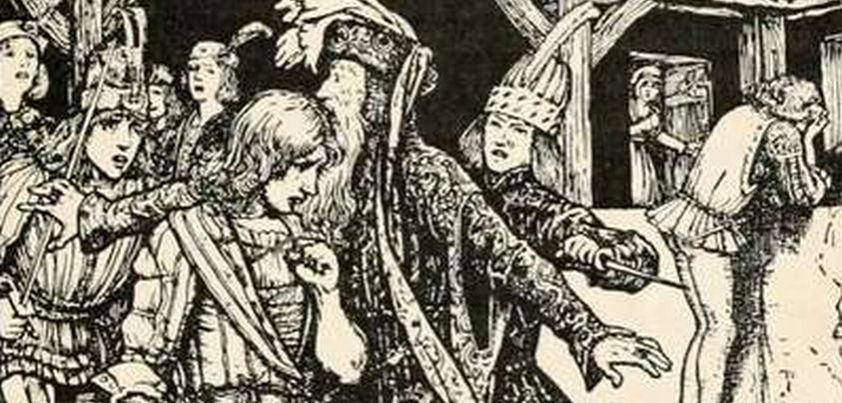
The Masque of the Red Death: Short story by Edgar Allan PoeIn this Edgar Allan Poe classic an eccentric, possibly mad prince of an unnamed country hopes to evade a plague known as the “Red Death” by locking himself inside a secluded abbey. Being a fun-loving fellow, he brings along an entourage comprising a thousand hale and light-hearted friends from among the knights and dames of his court and an unspecified number of servants and entertainers. They have a jolly time culminating in a lavish masquerade ball where the Red Death incarnate joins the party. Themes include the inevitability of death, fear, social class (abandonment of the common people), foolishness (madness?).

Continue ReadingThe Masque of the Red Death

Spunk

Spunk: Short story by Zora Neale HurstonIn Zora Neale Hurston’s Spunk, a mild-mannered man (Joe) is killed when he bravely but foolishly confronts his cheating wife and her macho lover. The story raises some interesting questions. Did Joe act out of love for his wife, or shame because she had humiliated him? Why did he stop at a store on the way? Was he hoping the “loungers” would talk him out of going, and too weak to back down when one of them encouraged him? Finally, who or what caused Spunk to fall into the saw? Themes include love and passion, courage and fear, the supernatural.

Continue ReadingSpunk

We Are All One

We Are All One: Chinese Folktale from Laurence YepIn this Chinese folktale retold by Laurence Yep, a rich merchant offers a large reward to anyone who can cure his painful eye disease. A poor candy peddler walks deep into a forest in search of a magical herb his mother had told him about. With help from a magical centipede and thousands of ants he becomes “One” with, he returns home with something better, earns the reward and lives happily ever after. The titular theme, that we are all one, conveyed an important social message to early Chinese immigrants in America.

Continue ReadingWe Are All One