The Water-Faucet Vision

The Water-Faucet Vision: Short story by Gish JenIn this humorous story by Gish Jen, a Chinese-American woman whose mother recently passed away reflects on a brief period in her childhood when her mother somehow fell out of their bedroom window. At the time of the fall she was a fifth grader in a Catholic school, obsessed with the idea of becoming a martyr and performing miracles. When her precious comfort beads fall through a drainage grate in the road, she wakes to a “vision” telling her how to recover them. Themes include religious belief, marital conflict, family, friendship, loss.

Continue ReadingThe Water-Faucet Vision

The Underground Gardens

The Underground Gardens: Short story by T. C. BoyleThis story by T. C. Boyle is a fictional account of the founding of California’s Forestiere Underground Gardens by an Italian immigrant in the early 1900s. The immigrant is initially disheartened to find that 70 acres of land he bought by mail order is too dry and hard to farm. He survives by working as a day laborer on other farms and, spurred on by a love interest, hand digs a subterranean mansion in his spare time. When the woman rejects him, he keeps on digging. Themes include faith in oneself, self-sufficiency, infatuation, appearance, perseverance, vision.

Continue ReadingThe Underground Gardens

Meneseteung

Meneseteung: Short story by Alice MunroIn this story by Alice Munro, an unreliable narrator purports to describe the adult life of a woman whose family moved to the wilds of Canada West (modern day Ontario) in 1854. Alone in the world following the death of her father, she publishes a book of poems and initially lives an ordered, contented life. One morning a traumatic discovery introduces her to the dark side of humanity and drives her into isolation and madness. Themes include gender roles in the 19th century Canadian West, art and the artist, alienation, loneliness, gossip, violence.

Continue ReadingMeneseteung

Africans

Africans: Short story by Sheila KohlerSaid to be an allegory of power relations between individuals in a colonial setting, the major themes of this story by Sheila Kohler are oppression and betrayal. An Afrikaner betrays his family through a combination of physical assaults, homosexual encounters, and inappropriate touching of his son’s classmates. His wife betrays him with an overseas affair, and her son and his classmates by not reporting his paedophilic tendencies to the police. Lastly, the wife’s “loyal” African servant since childhood betrays her in a moment of need. Other themes include family, gender roles, sexuality, domestic violence, fear, loyalty vs. duty.

Continue ReadingAfricans

Unnecessary Things

Unnecessary Things: Short story by Tatyana TolstayaThe message of this story by Tatyana Tolstaya is the need to let go of things that are no longer important to your life. The protagonist, who is moving alone into a new apartment, finds the remains of her childhood teddy bear while rummaging through a cupboard in her parents’ house. The find brings back long-suppressed memories and results in a feeling of overwhelming nostalgia. Sleeping next to the bear that night, she decides it has to go. Themes include hoarding, the relationship between objects, memories and feelings, sentimentality, moving on.

Continue ReadingUnnecessary Things

The Blue Bead

The Blue Bead: Short story by Norah BurkeThis story by Norah Burke explores the simple, yet dangerous life of junglis (jungle and wild forest dwellers) in colonial India. A twelve-year-old girl, whose “life from birth to death is marked for work”, dreams about being able to complete a necklace she has started to make. When she saves a villager by fighting off a four-meter crocodile, she is more excited by a blue bead she later finds in the water than the danger she faced. Themes include poverty, life and survival in the forest, gender roles, perseverance, courage, reward/karma, finding happiness in small things.

Continue ReadingThe Blue Bead

Menagerie, a Child’s Fable

Menagerie, a Child’s Fable: Short story by Charles JohnsonLike George Orwell’s Animal Farm, Charles Johnson’s confronting allegorical fable about animals left to fend for themselves in a locked pet shop is not for children. Some see the story as a religious allegory for the consequences (chaos and hell fire) of losing faith in God (Tilford) and listening to the devil (the monkey). Another interpretation is as a political allegory for the anarchy that can arise after a breakdown of authority and the rule of law, much like modern day (2024) Haiti. Themes include oppression, freedom and democracy, pluralism vs. racism, lawlessness and power (greed, violence, murder and rape).

Continue ReadingMenagerie, a Child’s Fable

The Mesmerizer

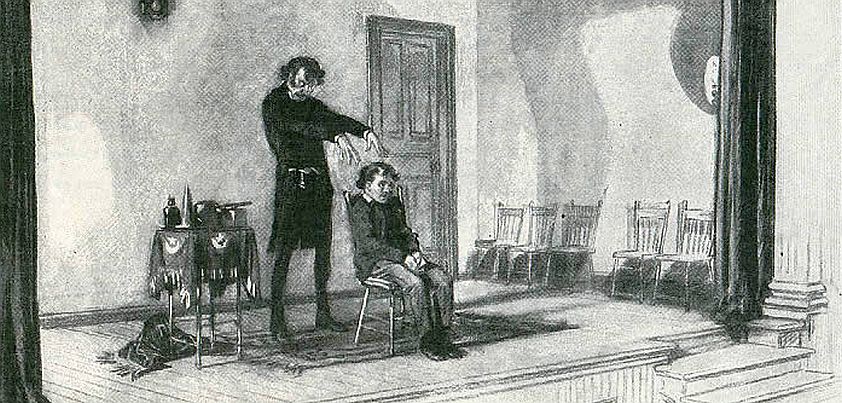
The Mesmerizer: Short story by Mark TwainIn this story taken from the Autobiography of Mark Twain, the author reminisces about a childhood prank that still haunts him in adult life. When a traveling mesmerizer (hypnotist) came to town, young Twain volunteered as a subject to show off before the public … and make the people laugh and shout and admire. His performance was so convincing that he fooled everyone in town. Later in life he comes to regret the deception, but learns that it can sometimes prove very difficult to undo a lie. Themes include showmanship, deception, the temporary nature of fame, cruelty, gullibility.

Continue ReadingThe Mesmerizer