The Colour Out of Space

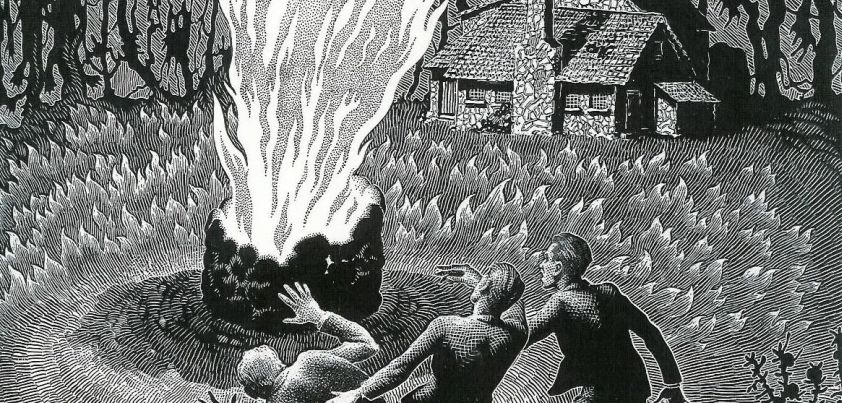
The Colour Out of Space: Short story by H. P. LovecraftIn this cosmic horror story by H. P. Lovecraft, a surveyor becomes curious about five acres of grey desolation known as “blasted heath”. He learns that a meteor like no other found on earth had landed near a farmhouse on the site. Within the meteor scientists found a globule of unearthly colour which, when cracked open, released a presence that caused every living thing nearby to mutate. Plants grew unnaturally large but were inedible. Animal life, including the farming family, went mad and deformed into grotesque shapes before dying. Themes include curiosity, fear, scepticism, the supernatural, realms beyond human understanding.

Continue ReadingThe Colour Out of Space

The Million Pound Bank Note

The Million Pound Bank Note: Short story by Samuel Clemens (aka Mark Twain)This humorous story from Samuel Clemens (aka Mark Twain) explores two themes related to the power of money. The first is the different attitudes people have towards the rich and the poor. The second, which is particularly relevant today, is the power the rich (influencers) can exert over the decision-making of admirers (followers). Other themes: enduring love (Portia and Henry’s relationship prospers, despite their playful deceptions); honesty (Henry’s intention to pay back his debts); and the peculiarities of British High Society (settling arguments with bets, determining social position through gossip columns, and missing meals if unable to decide seating precedence).

Continue ReadingThe Million Pound Bank Note

Barn Burning

Barn Burning: Short story by William FaulknerBarn Burning by William Faulkner is a story of how a ten-year-old boy rises above the intimidation and bullying of his embittered father. The father’s simmering anger stems from jealousy and lack of respect, fueled by an exploitative sharecropping system that keeps tenant families like his in perpetual poverty. He seeks retribution through senseless acts of arson (barn burning) against landholders he believes have slighted him. The boy, sensing the immorality of his father’s actions, has the courage to rebel and do something about it. Themes: family, class, alienation, exploitation, pride, anger, revenge, loyalty vs. morality, courage, betrayal.

Continue ReadingBarn Burning

A Girl Like Phyl

A Girl Like Phyl: Short story by Patricia HighsmithThe major themes of this story by Patricia Highsmith are shattered dreams, hypocrisy, betrayal and the fragile nature of identity. A chance meeting with an eighteen-year-old girl at an airport revives bittersweet memories for a successful, seemingly happily married businessman. The girl, who bears a striking resemblance to his long obsessed over ex-girlfriend Phyl, later ends up in his hotel room and tries to seduce him. When he learns the next day that she is Phyl’s daughter and observes Phyl berating her for spending the night in a stranger’s room, his self-esteem and outlook on life are destroyed.

Continue ReadingA Girl Like Phyl

Camp Cataract

Camp Cataract: Short story by Jane BowlesThis story from Jane Bowles examines the toxic relationship between three troubled sisters who share a city apartment. One of them is midway through a ten-week holiday in a Camp Cataract cabin as part of a long-term plan to move out and live independently. When another turns up uninvited, hoping to convince her to cut the holiday short, they arrange to meet for lunch the next day. Both have different recollections of what happens the following morning. Madness intervenes, and only one of them survives the day. Themes: self-analysis, identity, independence, mental illness, spinsterhood, female relationships.

Continue ReadingCamp Cataract

The Gioconda Smile

The Gioconda Smile: Short story by Aldous HuxleySuperficially Aldous Huxley’s Gioconda Smile is a straightforward story about a narcissistic womanizer who learns to his cost the meaning of the expression: Hell hath no fury like a woman scorned. On another level, it is a wonderful satire of the lavish, hedonistic lifestyles of upper-middle-class 1920s British society. The protagonist’s apparent lack of conscience may be due to his admitted psychopathy (not only did he not feel sympathy for the poor, the weak, the diseased, and deformed; he actually hated them). This raises the question: did he really deserve his fate? Themes: vanity, philandering, class, passion, murder, rejection, betrayal.

Continue ReadingThe Gioconda Smile

The Adventure of the Speckled Band

The Adventure of the Speckled Band: Short story by Arthur Conan DoyleThis story, considered by Arthur Conan Doyle to be his best Sherlock Holmes mystery, features one of his most creative (and unlikeliest) murder plots. Thirty-year-old Helen, Holmes’s client, is a victim of Victorian attitudes towards women. Fearing for their future, her dead mother had decided that she and twin sister Julia would not receive their inheritances until they married. Their violent stepfather, who manages the money, will become destitute should either of them wed. After announcing her engagement, Julia dies under mysterious circumstances. Helen fears that she will be next. Themes: decay, isolation, fear, murder, class, greed, hasty judgement, justice.

Continue ReadingThe Adventure of the Speckled Band

Rappaccini’s Daughter

Rappaccini's Daughter: Short story by Nathaniel HawthorneThis story from Nathaniel Hawthorne takes the “mad scientist” motif to a new level. Renowned physician Rappicini is fascinated with the curative power of deadly plants. An experiment that makes his young daughter immune to their poison comes at a terrible price: her skin and breath become toxic to others. As the poor girl grows into womanhood, the twisted doctor decides to make a potential partner immune to her poison. Unfortunately for all, a scientific rival plants a different kind of poison in the man’s heart and hands. Themes: science vs. morality, innocence, nature, oppression, isolation, envy, love, betrayal.

Continue ReadingRappaccini’s Daughter