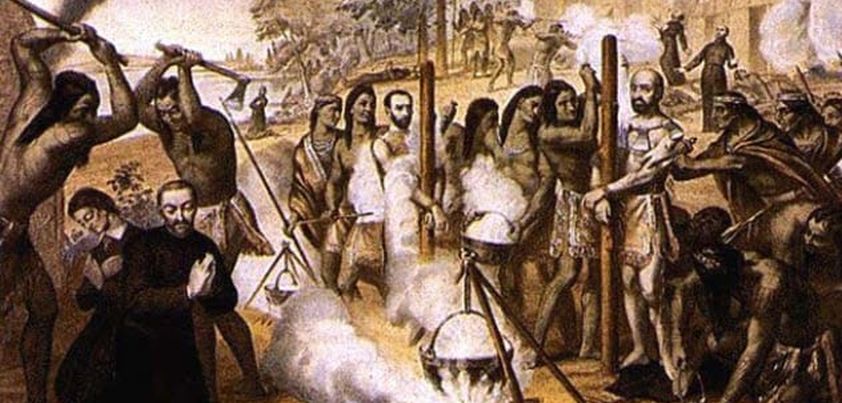
 This early Tobias Wolff story is about a college history professor who has always played it safe by expounding non-controversial views. When her East Coast school of fifteen years closes, she finds tenure in Oregon. However, the climate is not to her liking. After gaining an interview for a position in a prestigious college in upstate New York, she learns that she is a token female candidate with no chance of success. Part of the application process is a lecture, where she finds her own voice for the first time. Themes: identity, betrayal, manipulation, academic integrity, conformity vs. original thought. More…
All posts by shortsonline
The Short Happy Life of Francis Macomber
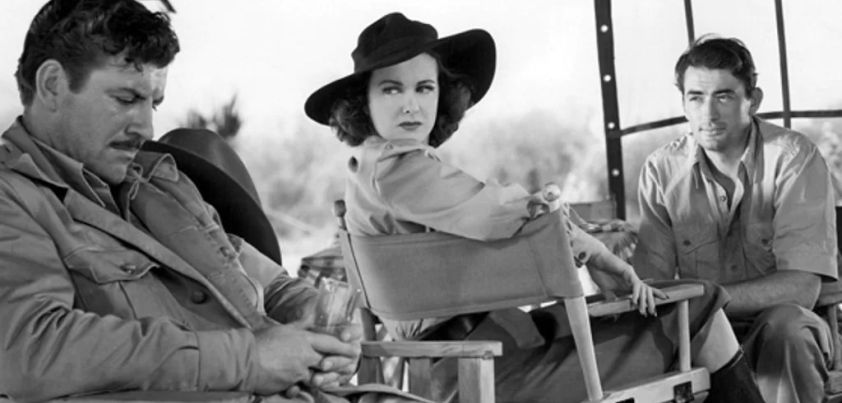 Author Ernest Hemingway goes to great lengths to set up an ambiguous ending to this story about a rich American couple’s fateful big game hunting safari in Africa. No longer (and perhaps never) in love, the couple barely tolerate each other. She can’t afford to divorce him, and he is unlikely to find a more attractive trophy wife. Readers are left to consider whether Francis’s death was murder or an unfortunate accident. What do you think? The major themes are clearly courage and masculinity. Other themes: fear; shame; violence; marriage breakdown; beauty & aging; adultery; misogyny & female stereotyping. More…
Folie à Deux
 In William Trevor’s Folie à Deux (foolishness shared by two), the protagonist’s chance meeting with a childhood friend brings back memories of a joint act of animal cruelty on an Irish beach. The protagonist has moved on; his friend Anthony has not. Anthony’s way of dealing with his guilt was to withdraw into himself. Over thirty years later, having “disappeared” and been presumed dead, he lives a solitary, reclusive life in Paris, still unable to shake off self-reproach for his part in their actions. Themes: friendship, shared secrets, childhood cruelty, guilt, alienation, rumination (obsessive reliving of traumatic events). More…
Animal Farm
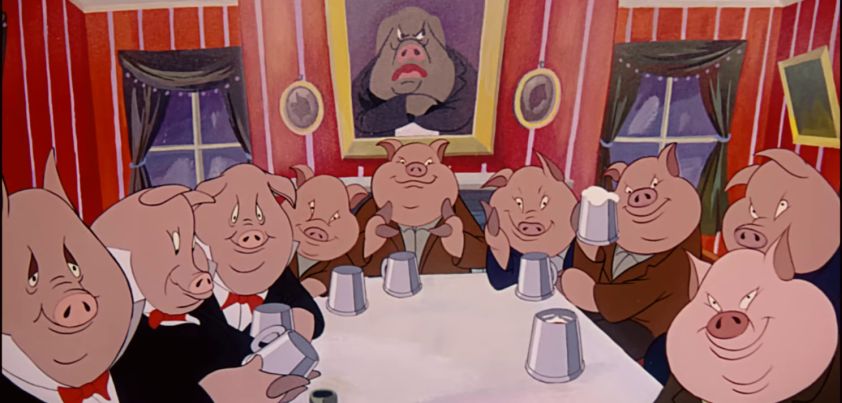 Given events taking place in modern-day Russia, it is timely to revisit this classic political satire from George Orwell. Included in Time Magazine’s list of the 100 best English language novels, the story is an allegory of the 1917 Russian Revolution and rise of Stalinism. Major themes (and the reasons for its relevance today) are the lust for and corrupting effect of power, and how an unenlightened populace can be manipulated into continued acceptance of a failed/corrupt political system. Other themes: idealism, political transition (autocracy→ socialism→ communism→ autocracy), class, animal cruelty (= exploitation of the working class). More…
The Bottom-Pincher
 Khushwant Singh’s writing is known for its use of satire and irony in addressing controversial aspects of Indian life. This humorous story is about an admitted “bottom-watcher” who dreams of becoming a “bottom-pincher”. When he encounters a serial bottom-pincher, he becomes obsessed and stalks the man, obtaining vicarious pleasure from his exploits before succumbing to the temptation himself. The major theme is hypocrisy: the facade of respectability adopted by wealthy Indian men who might pop out for a lunchtime “nooner” or engage in other salacious activities. Additional themes: sexual assault (unwanted touching), perversion, obsession, stalking, harassment, temptation, corruption, poverty. More…