 This story from Manoj Das contrasts the innocence of a six-year-old girl with the intolerance of her village priest and the hypocrisy of corrupt temple officials. After dreaming that her deity spoke to her, the girl sneaks into the temple and has a wide-ranging “discussion” with him, including his problems (hearing and too many bananas), hers (arithmetic), and her family’s (an aggressive money-lender). On leaving with two bananas from his shrine, she is chased by an angry mob into a pond in which she catches a fatal fever. Themes include innocence, faith, family, poverty, righteous indignation, guilt and remorse. More…
Papa, What Does that Spell?
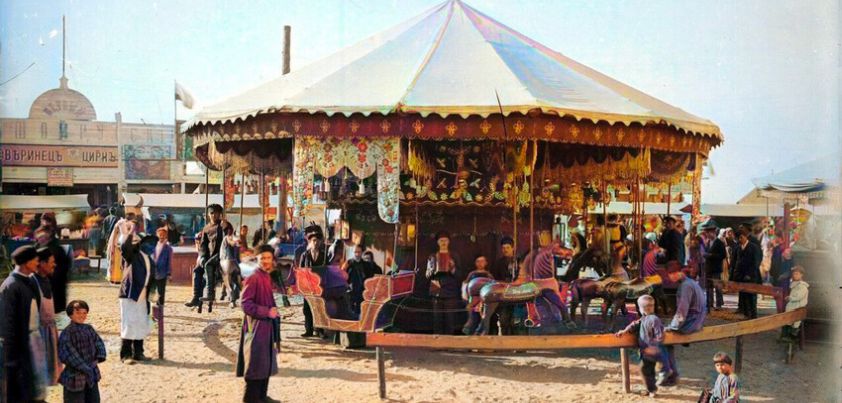 In this story by Vasily Aksyonov (Aksenov), a Russian factory worker reviews his life and relationships as he spends a day with his six-year-old daughter while his wife is at a “meeting”. He is growing apart from a once close-knit group of childhood friends, and faces a growing gap with his wife who is completing a doctoral degree and may be having an affair. In an epiphany, he realizes that being there for his daughter as she grows up is the most important thing in the world. Themes include childhood innocence, fatherhood, social relationships, marriage disconnect, deceit. More…
The Disk
 Jorge Borges gives this story a timeless quality by setting it in medieval times and framing it like a fairy-tale. A traveler arrives at an isolated woodcutter’s hut claiming to be an exiled king descended from Odin, the Norse king of the gods. He supports this by showing the woodcutter what he claimss to be the disk of Odin, the only one-dimensional object in the universe. Ironically, the woodcutter answers: I do not worship Odin, I worship Christ… and then kills him to possess Odin’s disk. Theme: the desire to own something that holds power over the world around us. More…
As If It Had Never Happened
 In this story by Witthayakon Chiangkun, a busload of enthusiastic Bangkok college students descend upon an isolated, poverty-stricken rice farming village as part of a 1960s national community development program. Despite their best efforts, differences in speech, dress and perceived social class make integration difficult. They have been sent during their school vacation to build a Community Hall, something the contented villagers neither asked for or need. Apart from the narrator, a young teen, the Hall’s only users are water-buffaloes seeking shelter from the sun. Themes include identity, innocence, city vs. country cultural divide, politicization, benevolence, bureaucratic disconnection. More…
The Kiss
 In this Anton Chekhov story, a mistaken kiss in a darkened room temporarily transforms the life of a shy, insecure army officer. He returns to duty on a high, wondering who the woman was and fanaticizing that he could be as successful in love and life as his fellow officers. Some weeks later, he eagerly returns to the scene. When nothing special takes place, he sees the folly of his summer dreams and fancies. In addition to Chekhov’s common message of the cruelty and unpredictability of life, themes include misunderstanding, human desire, self-delusion, raised hopes and shattered dreams. More…