 Hwang Sun-won’s Cranes shows how humanity can outweigh ideology. Two childhood friends find themselves on opposite sides in the Korean War. One, a village commander, is captured and the other assigned to take him for interrogation and probable execution. When asked why he did not flee, the captured man talks about his aged father’s connection to the land. The other man can relate to this, because he carries the guilt of having left his family when he went away to war. This prompts the captor to suggest they go off on a crane hunt, as they did once as boys. More…
Tobermory
 This story by Saki is a satire of early twentieth century British high society. A group of socialites attend a weekend house-party. Among the guests is a visiting scientist who was invited in the hope that his cleverness would contribute to the general entertainment. All are amazed when he teaches Tobermory, the family housecat, to speak perfect English. However, their surprise soon turns to anger at some of the things Tobermory has to say. This seals Tobermory’s fate… he knows too much and must be silenced! Themes include wonder, superficiality and hypocrisy, embarrassment, anger, retribution More…
Pillar of Salt
 In this story by Shirley Jackson, a New Hampshire couple’s idyllic holiday in New York goes awry when the woman panics after falsely thinking a building they were in was on fire. She sees the once bright, exciting city differently, losing confidence among the crowds and imagining decay everywhere. When the couple discover a body part on a Long Island beach, she spins out of control. The next day, alone on a crowded sidewalk, she is too scared to even cross the street. Themes include loss of identity (powerlessness and invisibility among the crowds), anxiety, paranoia, fear. More…
The Life You Save May Be Your Own
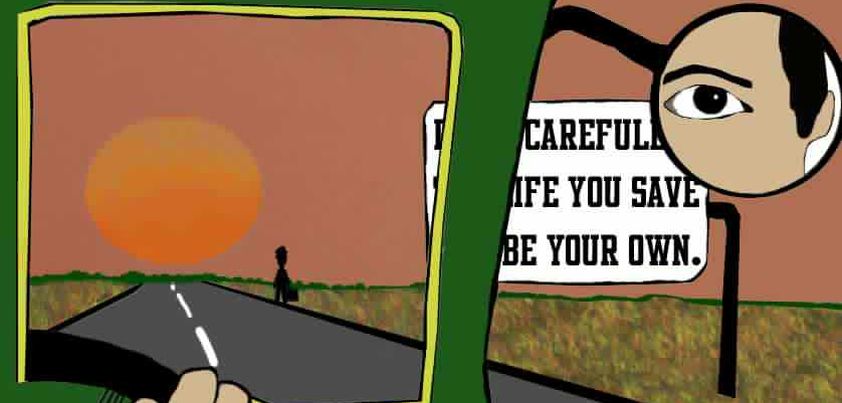 In this Flannery O’Connor story a cynical, manipulative, one-armed drifter is given a chance at redemption (settling down to a “better” life) by an equally manipulative mother desperate to secure a future for her mentally handicapped daughter. Rather than the daughter, the man only has eyes for the family’s “barn-find” automobile. Immediately after their wedding, he leaves the girl to an uncertain future at a roadside diner and drives on alone. Perhaps out of guilt, he unsuccessfully tries to absolve himself from the moral consequences of his actions by doing a good deed. Themes: disability, devotion, desperation, deception, redemption, independence. More…
Looking for Mr. Green
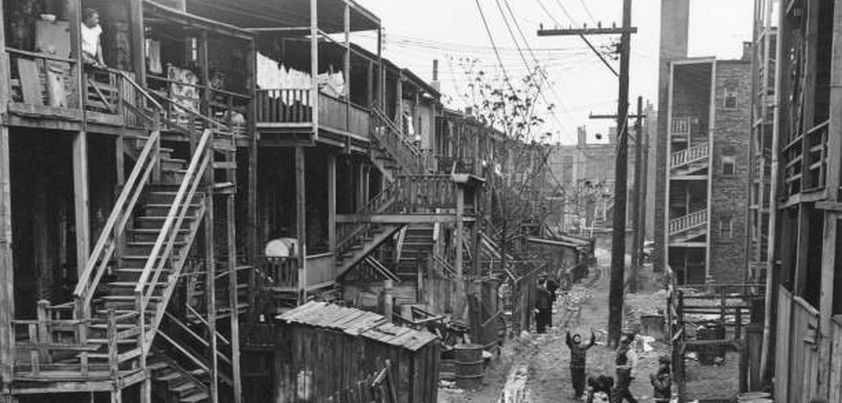 A major theme of this story by Saul Bellow is work ethic. Times are tough in 1930s Chicago. An intellectual white man starts a much-needed job delivering unclaimed welfare checks to people in a depressed black neighborhood. On his first day his younger supervisor implies that, as a city worker, he isn’t expected to “push too hard”. That’s not the way he works: he wants to do well for doing-well’s sake, and goes above and beyond in a quest to find the elusive Mr. Green. Other themes include poverty, race, suspicion, duty, tenacity, identity. More…