The Argentine Ant

The Argentine Ant: Short story by Italo CalvinoThis story from Italo Calvino starts off aslike a horror story. A young couple with a baby move to a peaceful seaside village looking for work, only to discover that the whole place is crawling with ants. After they find the baby covered in ants and their food destroyed, Calvino takes a playful turn. He goes on to describe the sometimes farcical ways villagers try to exterminate and/or pretend they are not affected by the invaders, and the couple’s embarrassing confrontation with the reportedly self-serving government “Ant Man”. Themes: co-existing with nature, powerlessness, futility, tolerance/accepting the inevitable, mob hysteria.

Continue ReadingThe Argentine Ant

The Turning

The Turning: Short story by Tim WintonThis story from Tim Winton includes themes of alcohol abuse, domestic violence, child neglect, shame, friendship and faith. A mother of two whose hard-drinking husband is increasingly violent towards her becomes close friends with a “Ken-and-Barbie” like new couple in town. When the couple share a story of how religious faith helped turn their lives around, she rejects the notion as not for her. Later, the impulsive purchase of a novelty “snow dome” featuring a hunky-looking Jesus walking on water not only provides amusement, but also becomes the catalyst for an epiphany as she endures a brutal marital rape.

Continue ReadingThe Turning

The Fun They Had

The Fun They Had: Short story by Isaac AsimovThis story by Isaac Asimov is set in the year 2155. A boy shows a friend something strange he found hidden away in his family attic. Neither of them has seen one before… it is a book! First, they discuss how wasteful paper books were compared to electronic books of their day. The book is about school, and they go on to compare home schooling of the future with “going to school” in the past. Themes include technological progress, human connection (computer-driven vs. classroom learning), paper-based vs. electronic reading, memories, longing for aspects of the past.

Continue ReadingThe Fun They Had

Dragon, Dragon

Dragon, Dragon: Short story by John GardnerThe central theme of this humorous story by John Gardner is to respect the views of one’s elders. A dragon ravages a medieval kingdom with some modern touches (clocks, novels, cars and cigars). When the king’s knights and wizard prove ineffective, he calls a town meeting to ask for ideas, promising his daughter’s hand and half his kingdom to anyone who can slay the dragon. After the two older sons of a wise cobbler ignore their father’s advice and fail, their nervous younger son heeds his words and succeeds. Other themes include social class, honor, and courage (overcoming one’s fears).

Continue ReadingDragon, Dragon

The Treasure of Abbot Thomas

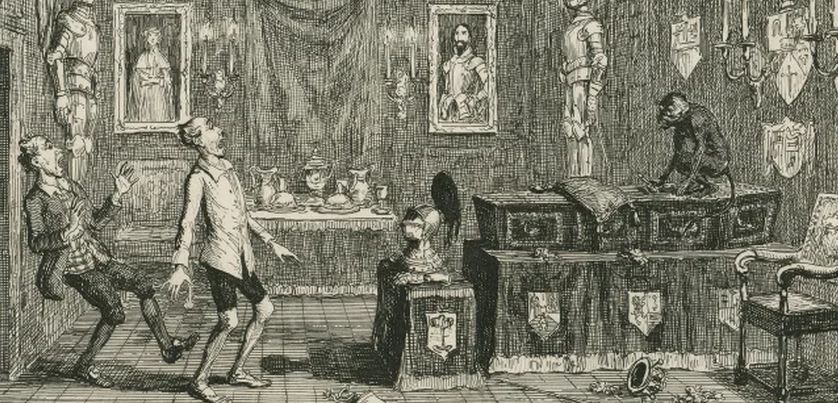
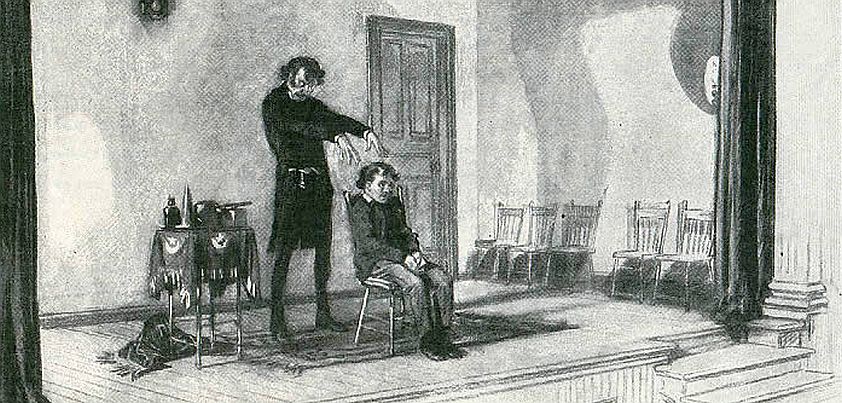
The Treasure of Abbot Thomas: Short story by M. R. JamesIn this story by M. R. James, a British antiquary comes across an old book written in Latin that tells of a German monastery in which a fortune in gold is believed to have been hidden. He believes the key to the treasure lies on a stained-glass window removed from the Abby and returned to England when the monastery was closed. He finds the window, decodes the message hidden on it and, despite the warning contained in the message, finds the gold. His only problem… dealing with the treasure’s monstrous guardian. Themes include treasure hunting, cryptography, fear, the supernatural.

Continue ReadingThe Treasure of Abbot Thomas

The Voter

The Voter: Short story by Chinua AchebeThis story by Chinua Achebe uses irony to highlight vote-buying in Nigerian village elections. A sitting politician’s wealth and lifestyle have improved dramatically since being elected. To retain his place at the trough, he appoints a group of canvassers to bribe influential villagers. His most trusted canvasser faces a dilemma, He is offered an unheard-of bribe to vote for the opposition, provided he swears on a talisman that will bring ill-fortune if he doesn’t do so. He takes the money, and creatively finds a way to avoid being disloyal to either party. Themes include corruption, politics, vote-buying, superstition, loyalty.

Continue ReadingThe Voter

Immortality

Immortality: Short story by Yiyun LiYiyun Li’s story exploring aspects of China’s transition from empire to communist super-power is unusual in that its point of view is not that of a single character, but rather the collective voice of a rural community. Central themes are lack of power of the individual (symbolized by emasculation), and abuse of power by the ruling classes. Secondary themes are the methods adopted by the Communist Party to consolidate its power (indoctrination through cultism, repression and fear), and the changes taking place as modern technology exposes the masses to Western lifestyles and values.

Continue ReadingImmortality

The Prisoner Who Wore Glasses

The Prisoner Who Wore Glasses: Short story by Bessie HeadThis story from Bessie Head is about a group of political prisoners who unite to survive the harsh South African penal system. Physically, the main character (Brille) is the weakest of the span of ten prisoners. This is reflected in his build, his clumsiness, and his poor eyesight. Brille compensates for these weaknesses with strength of character and insight. A beating from a warder helps him see that he entered politics for the wrong reason; it also shows him a way to manipulate the warder to improve things for the whole span. His glasses symbolize both weakness and perceptiveness.

Continue ReadingThe Prisoner Who Wore Glasses

Hominids

Hominids: Short story by Jill McCorkleIn this story by Jill McCorkle, a woman hosting a dinner party for a group of her husband’s old friends is disgusted by the way the men joke about the bodies of women they had encountered at a strip club earlier in the day. She muses about modern man’s obsession with breasts, and the contrast between the privileged life of the wives present and the circumstances that might lead other women to take up such work. She confronts the men, along the way cynically threatening to open her own club called “Peckers”. Themes include machismo, sexualization, misogyny, beauty and womanhood.

Continue ReadingHominids

Snow, Glass, Apples

Snow-Glass-Apples: Short story by Neil GaimanThis Neil Gaiman story is yet another re-invention of the Snow White tale. However, a shift in point-of-view from a third-person omniscient narrator to the first-person perspective of the Queen allows the story to be re-imagined in a way we are unlikely to see from Disney. The much-maligned Queen knows a little magic (enough to glimpse the future and enchant the King), but not enough to match her evil stepdaughter. In the end, the Queen’s fate adds a new meaning to the slang term to feel cooked. Themes include power, vampirism, murder, revenge, jealousy, cruelty, sexual depravity (necrophilia, pedophilia, incest).

Continue ReadingSnow, Glass, Apples