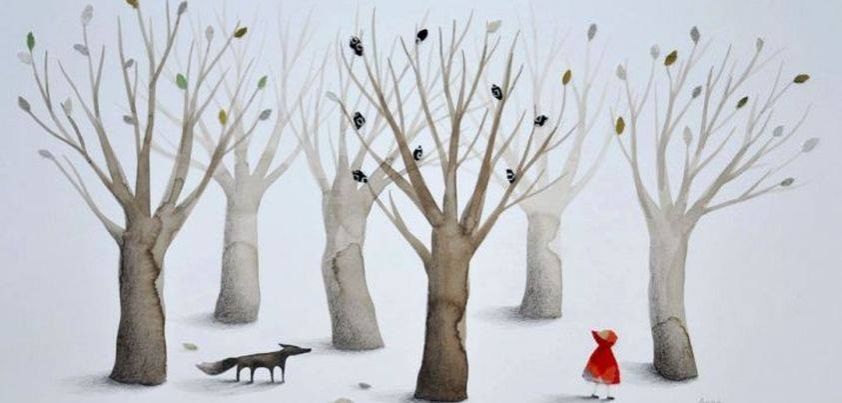
 This time last year we featured Charles Perrault’s famous interpretation of an ancient folktale, Cinderella. Today we have another well-known Perrault story, Little Red Riding Hood. The version of the story most commonly told today is from a Brothers Grimm adaption known as Little Red Cap, published over 100 years after Perrault. In both versions, Red is punished for talking to strangers (the wolf) by being “eaten”. The Brothers extended the story to make it more appealing to children. In addition to Red and her grandmother miraculously surviving in the wolf’s stomach, they later meet and kill a second wolf. More…
Tong
 This story by Francisco Sionil José follows a courtship between a Filipino accountant and young Chinese woman. The relationship faces opposition from their families as inter-cultural (especially Filipino-Chinese) marriages are frowned upon by both communities. Moreover, one obstacle not easily overcome is a “tong” (debt that must be repaid). The girl is promised to a fat, bald Chinese man old enough to be her father in exchange for favors done for her family. After a passionate final night together, they are separated forever. Themes include forbidden love, cultural division and conflict, socioeconomic inequality, exploitation/human trafficking, family honor and loyalty. More…
The Water-Faucet Vision
 In this humorous story by Gish Jen, a Chinese-American woman whose mother recently passed away reflects on a brief period in her childhood when her mother somehow fell out of their bedroom window. At the time of the fall she was a fifth grader in a Catholic school, obsessed with the idea of becoming a martyr and performing miracles. When her precious comfort beads fall through a drainage grate in the road, she wakes to a “vision” telling her how to recover them. Themes include religious belief, marital conflict, family, friendship, loss. More…
Marigolds
 In Eugenia Collier’s Marigolds the protagonist comes of age (or in her words loses her innocence) when caught in a senseless act of destruction. Angry about her father’s shame over not being able to find work, she lashes out at the garden of a neighbor who is trying to bring beauty and happiness into her life by growing marigolds. Ironically, the neighbor and her disabled son are even more destitute than the protagonist’s family. Themes: childhood memories, poverty, shame, envy, impulsiveness, empathy, guilt and possibly racism (the resentful references to “white folks” and comments about Miss Lottie’s “Indian-like” features). More…
The Bakery Attack / Second Bakery Attack
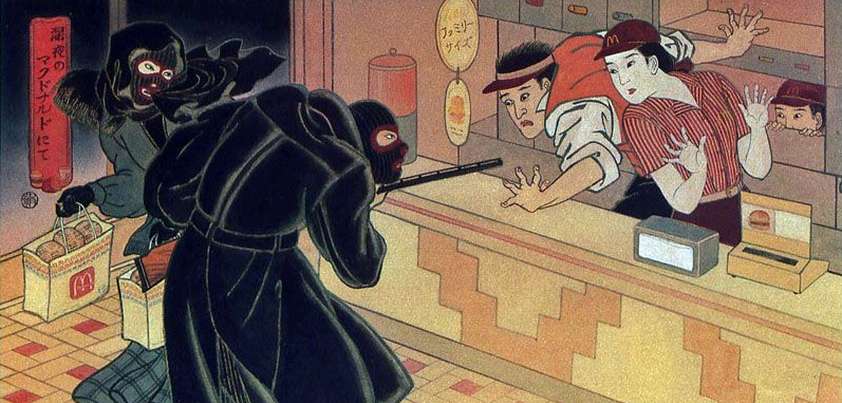 The Second Bakery Attack, one of Haruki Murakami’s most popular stories, is the sequel to an earlier, less well-known work. In the first story, an empty stomach symbolizes a life empty of ambition and intellectual stimulation. In the second, it symbolizes the insecurity inherent in a recently married couple’s (as yet) superficial relationship. The man has a lot to learn about his new wife, as becomes clear when she proves surprisingly adept at planning and carrying out a robbery. For the couple, the successful robbery proves a bonding, curse-lifting experience. Themes include marriage, insecurity, gender roles/’manhood’, the supernatural, change (Westernization). More…