 Acclaimed as one of Vladimir Nabokov’s best stories, Spring in Fialta’s is a haunting reminiscence of what was and might have been. A businessman travels widely across Europe. On many occasions, and in different cities, he coincidentally comes across and enjoys brief dalliances with the same enigmatic woman. Both are married and know each other’s partners. He has strong romantic feelings for her, but is unsure if they are reciprocated. A meeting in Fialta, in which he tentatively admits his love, is their last before her tragic death. Themes include memories and the past, fate, love and desire, death, loss. More…
Story in a Mirror
 In this intriguing story by Ilse Aichinger, a woman’s life “flashes before her eyes” as she dies in hospital from an infection following an illegal abortion. During her death struggle she looks forward, picturing her burial, and then travells backward in time, re-living key events all the way back to her birth. An interesting concept is that the journey brings redemption… In the mirror one does everything so that it may be forgiven. For example, it becomes clear that she didn’t want the abortion, but rather was ordered to by her controlling lover. Themes include, death, time, memories, regret, redemption. More…
The Cone
 When the manager of an iron-works takes an artist friend he knows to be sleeping with his wife on a tour of the furnaces, it seems inevitable that one of them will meet with an unfortunate ‘accident’. The power of this H. G. Wells story lies in its gradual build-up of suspense and vivid descriptions of the industrial landscape and smelting process. Major themes are adultery, revenge, violence and (for modern-day readers) environmental degradation. Ironically, when the story was published in 1895, readers would have identified the fourth theme as something akin to ‘progress’. More…
Recitatif
 This story by Toni Morrison explores the relationship between two women of different race who meet as eight-year-olds in a children’s shelter and become reacquainted at several points in the future. In addition to conflicts that arise as their lives move in different directions, both remain haunted by recollections of the ill-treatment received by a disabled kitchen-hand who worked at the shelter. An unusual aspect of the story is that although a major theme is racism, we never learn the ethnicity of the two women. Other themes: friendship, alienation, prejudice, disability, parenting, memory. More…
The Dinner Party
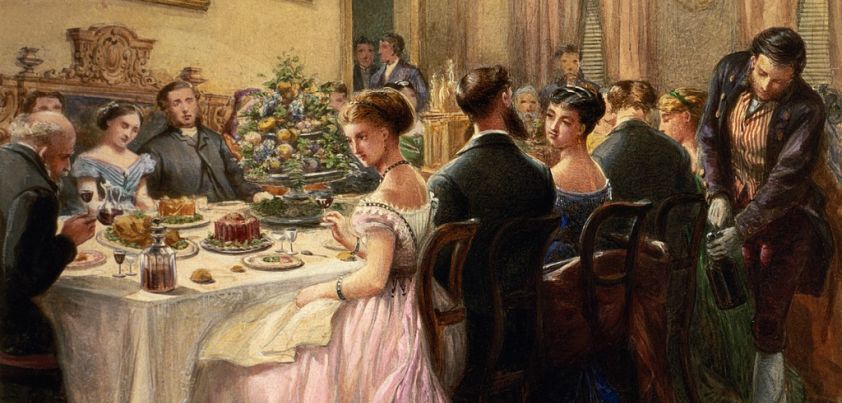 The theme of Mona Gardner’s The Dinner Party is gender stereotyping. The story is a satire of attitudes towards women in upper class colonial England. It begins with a debate over dinner between an army officer and young girl. The officer argues that men are better than women at staying calm during a crisis. The host’s wife proves him wrong by demonstrating nerves of steel when the guests are threatened by a deadly visitor. Although one of the other guests foreshadows the looming danger, the full extent of the woman’s courage is not evident until the final paragraph. More…