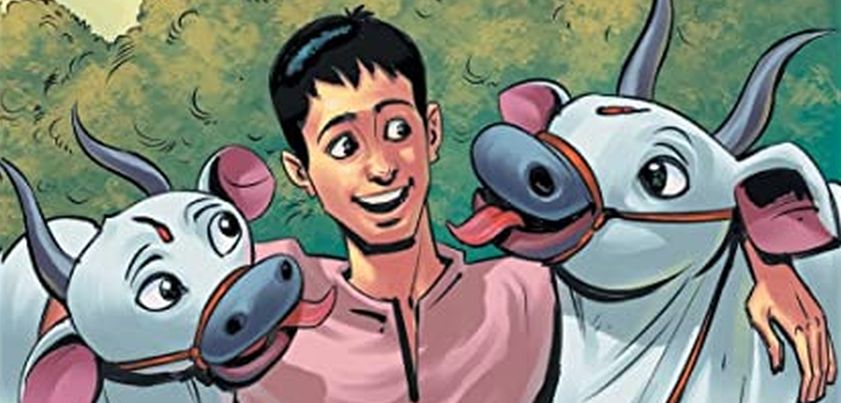
 This story by Premchand has three important themes: kindness to animals, friendship and faith. A series of adventures begin for two oxen (Hira and Moti) when Jhuri, their much-loved owner, lends them to his wife’s brother who lives far away. The brother-in-law mistreats the poor animals and, with the help of a kind girl, they run away. Their friendship gives them the strength to endure an attack by a raging bull, beatings and starvation before being sold to a butcher. As they almost lose hope and begin to question their faith in god, a ‘miracle’ helps them return home. More…
The Other Wife / Woman
 In this vignette by French author Colette, a recently married couple visiting a restaurant chance upon the husband’s ex-wife. She is attractive, sophisticated and self-assured. Alice, the new wife, is younger, naïve, submissive and insecure. The self-centered, controlling husband cannot understand why his first wife had “difficulty” with their relationship. The new marriage, in which Alice flirtatiously plays the part of a trophy wife, appears more to his liking. Unfortunately for him, the encounter raises doubts and a question in Alice’s mind: What more did she (the ex-wife) want from him? She finds herself envying and respecting the stronger woman. More…
The Minority Report
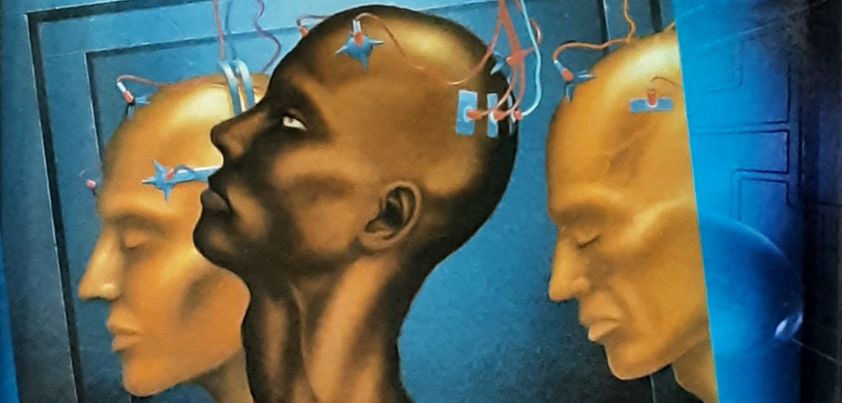 Philip Dick’s The Minority Report is a dystopian adventure story set in a society that takes policing a step even further than the infamous “Thought Police” in George Orwell’s Nineteen Eighty-Four. Its premise is that the authorities have found a way to identify a crime and imprison the would-be perpetrator before he or she even thinks of committing it. Their methods in doing this are disturbing to say the least. Themes: (general) free will vs. fate, injustice, trust vs. paranoia, self-fulfilling prophesy, extrajudicial murder; (for the “precogs”) violation of human rights, enslavement, degradation. More…
The Machine Stops
 This Science Fiction classic by E. M. Forster explores the role of “the machine” in the rise and fall of a future dystopian civilization. After developing the machine the population grow dependent upon it, become controlled by it, worship it, and are ultimately destroyed by it. In the process, they regress in terms of human interaction, family relationships, physical strength, critical thinking ability and free will. Only the “homeless”, who have no access to the machine, survive. The major theme is the danger of over-reliance on and losing control of technology. Other themes: environmental degradation, religious faith, freedom, rebellion. More…
Dahong Palay
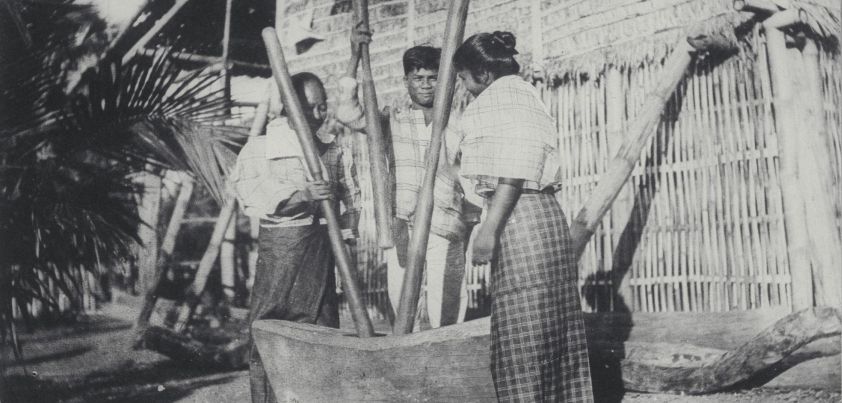 The Filipino term dahong palay has several meanings: a rice leaf, a single edged sword and, as in this story by Arturo B. Rotor, a deadly viper. A young man is the butt of constant jokes about his timid nature and slight build. An attempt to prove himself at a community rice-pounding gathering leads to further ridicule. Later, when bitten by a dahong palay to save his prospective girlfriend, he proves that resourcefulness, strength and courage aren’t dependent upon how well-built you are. Themes: community, body image, bullying, young love, courage. More…