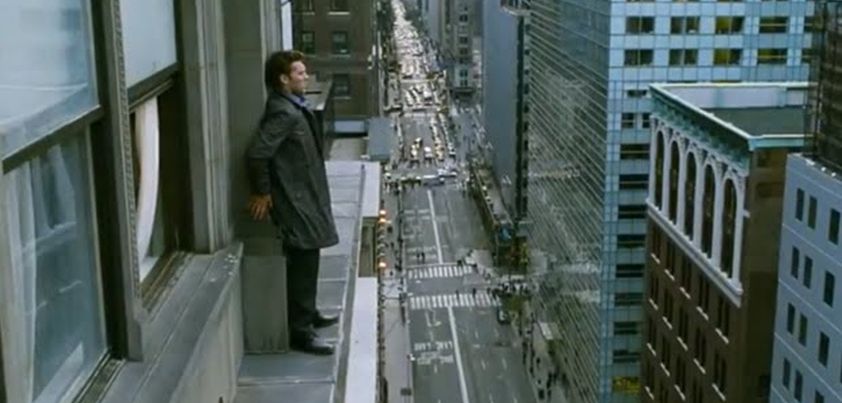
 This exceedingly suspenseful story by Jack Finney is a tale of drive, ambition and the pursuit of quick success taken too far. It also raises an interesting question: At what point does a material object become worth risking your life for? A man climbs out of a window onto the ledge outside his eleventh floor apartment to retrieve a piece of paper. Ironically, what is on the paper is “incomprehensible” to anyone but him, and could readily be replaced with two months of repeated research. Themes: misplaced priorities, risks vs. consequences, determination, fear, desperation, enlightenment. More…
The Pale Man
 This is a short horror story by little known author Julius Long. A doctor tells a man suffering from nerves to have a long holiday somewhere quiet. The man checks into a hotel in a small town. However, the townspeople are unfriendly towards him and he finds it a lonely, dreary place. His only hope for stimulating conversation appears to be a tall, pale man staying in another room of the hotel. The pale man has some very strange ways, so the man asks the hotel room clerk about him. The room clerk tells him there is no such guest. More…
Champoon
 This tragic story by Dhep Mahapaoraya is set in pre-World War 2 Central Thailand. A mentally disturbed young Thai man relates how, after he and the daughter of a fiercely protective Chinese towkay fell deeply in love, the girl was severely beaten, locked away by day, and chained at night. The determined girl escaped, but met a grisly end in the jaws of a crocodile after finding him taking solace with a young prostitute. He is haunted by the thought that her death may not have been accidental. Themes include love, cruelty, betrayal, corruption, prostitution, excess (alcohol, gambling, women). More…
Zero Hour
 This chilling story by Ray Bradbury involves an inattentive mother, a feisty seven-year-old girl, and her imaginary friend Drill. Throughout most of the story, the girl leads her friends in a construction game following instructions she receives from Drill. Her mother later learns that groups of children across America are playing the same game. Its name is “Invasion”, and for her the climax comes in a single word: Peekaboo. The major theme of the story is complacency. The mother senses something is wrong, but doesn’t act until too late. Other themes include human smugness (We’re impregnable!), childhood innocence/impressionability, manipulation, fear. More…
The Middleman
 The most succinct summary of this Bharati Mukherjee story I’ve seen came from a Goodreads review: An Iraqi Jew unwittingly aids a Central American revolution. There is obviously a lot more to it, including lust, arms smuggling, treachery and murder. Moreover, rather than being a revolutionary hero, the protagonist is an unscrupulous American criminal on the run from the law. Although he calls himself a “middleman”, we don’t see him act as such. Being new to the country, he is hoping to make a living from things that fall. And something certainly does! Themes: lust, corruption, exploitation, betrayal, violence. More…