 In this story by Che Husna Azhari, the men of a Malay village gather in the market square every morning to buy a nasi dish for breakfast. It is not that this nasi is any better than they would get at home, but rather because the vendor is an attractive young widow who mesmerises them with her swinging hips and easy smile. The village Imam is love-struck by the woman, who reminds him of his first, unrequited love, and convinces his devoted wife to let him have another. Themes include religious faith, patriarchy, desire, jealousy, love, polygyny, sacrifice. More…
The Extravagant Behavior of the Naked Woman
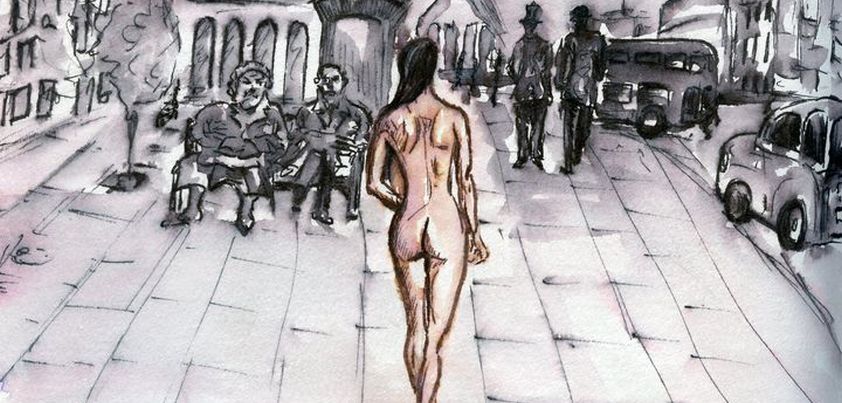 This very short story from Josefina Estrada appears in several international flash fiction anthologies. Its shock value helps to get across a number of important themes. Some are stated or can readily be implied: the woman is clearly suffering some sort of mental condition, but the community and police do not have access to services or facilities to help her. Other than a few lustful men, it is easier to turn away and pretend she does not exist. A less obvious theme lies in the question: What would happen if it were a wild-looking man walking naked through the streets? More…
Little Red Riding Hood
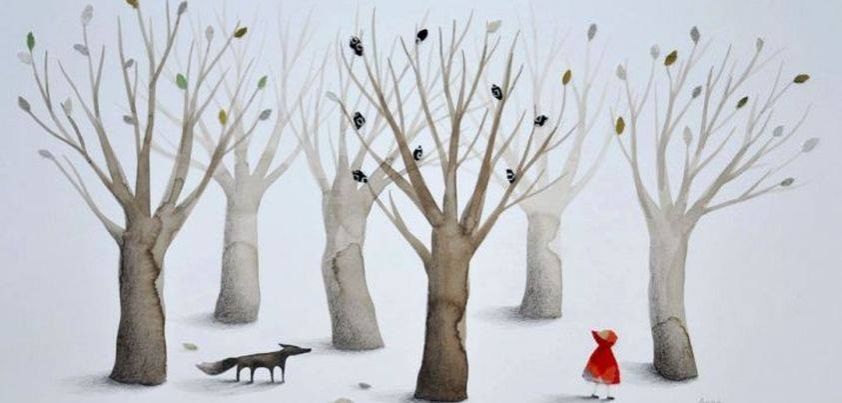 This time last year we featured Charles Perrault’s famous interpretation of an ancient folktale, Cinderella. Today we have another well-known Perrault story, Little Red Riding Hood. The version of the story most commonly told today is from a Brothers Grimm adaption known as Little Red Cap, published over 100 years after Perrault. In both versions, Red is punished for talking to strangers (the wolf) by being “eaten”. The Brothers extended the story to make it more appealing to children. In addition to Red and her grandmother miraculously surviving in the wolf’s stomach, they later meet and kill a second wolf. More…
Off
 In this story by Aimee Bender a conceited, deliberately overdressed woman attends a party with the stated objective of kissing three men of different hair color. Her character is defined in an anecdote about how she once named her Great Dane “Off” to play with the minds of other women at a dog park. The independently wealthy woman is highly insecure, struggling to fit in and form meaningful relationships. This results in bitterness and vindictiveness towards other women, and a demeaning climax as she tries to win kiss number three. Themes include self-admiration, loneliness, insecurity, jealousy and bitterness, hope. More…
Love in the Cornhusks
 On the surface, this story from Aida Rivera-Ford is about young love leading to an illegitimate child, a “disappearing” boyfriend, an unhappy marriage of convenience, affirmation of the boyfriend’s love, and taking responsibility for one’s actions. On a deeper level, questions arise as to whether the couple’s lovemaking was consensual or forced (She resisted but his arms were strong.). We also see elements of ethnic and class discrimination in the descriptions of Tinang’s Bagobo husband and her sense of superiority over the “darker-skinned” girls and other workers in the fields. Themes: prejudice, love, choices and consequences, regret, facing reality/moving on. More…