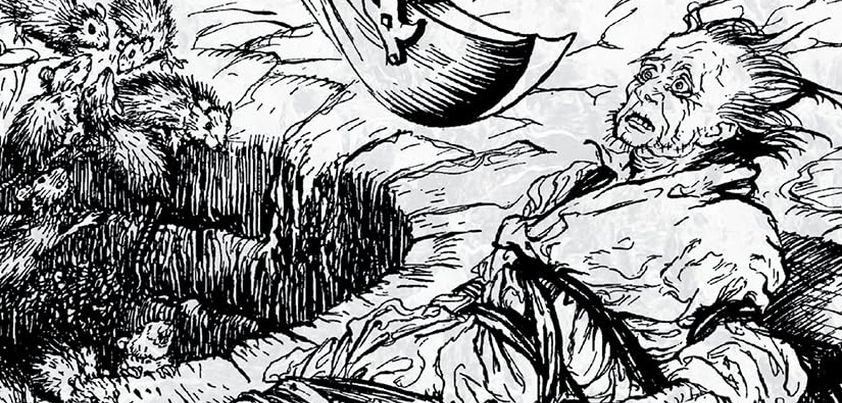
 In this story by Edgar Allan Poe, a man in a dreamlike state of consciousness swoons upon being sentenced to death by the Spanish Inquisition. He wakes to find himself tied to a wooden frame in a chamber housing three forms of horrific death: a deep, water-filled pit; a slowly descending, razor-sharp pendulum; and contracting, red-hot walls. After almost giving up and welcoming death, he finds the will to live and devises a plan to escape the pendulum. As the walls close in, an unexpected visitor saves him. Themes include injustice, sadism, fear, time, the will to live, inventiveness, salvation More…
Names/Nombres
 This is a personal essay reflecting incidents in the life of author Julia Alvarez. On the one hand, it examines the important relationship between name and identity in Hispanic culture. On the other, it highlights the desire for migrants, especially children, to ‘fit in’ with an anglicized name that is easily pronounced. Finally, we have her mother’s wisdom in saying that it doesn’t matter, quoting the English idiom A rose by any other name would smell as sweet. In the final paragraph, the girl wonders what name she will go by when she is well-known. We now know the answer! More…
Reunion
 John Cheever’s Reunion is about a boy (Charlie) who reaches out to meet his estranged father, only to learn that the man is a rude, possibly alcoholic attention-seeker who delights in putting other people down. Before the meeting, Charlie was curious to see what his father was like: he was my father, my flesh and blood, my future and my doom. I knew that when I was grown I would be something like him. In cutting the reunion short, Charlie shows that he has the power to defy nature and avoid following in his father’s footsteps. More…
When Darkness Falls
 One of Ruskin Bond’s strengths is his ability to portray characters that are so life-like readers can empathize with them. So it is with this tragic story of man so frightfully disfigured by war that he is afraid to leave his room by day, and confines himself to creeping phantom-like around an aging hotel by night. His loves in life are his books and music. The message of the story: before turning away from a grossly disfigured or disabled person, stop to consider the feelings of the human being within. Themes include appearance, fear, despair, the healing power of music. More…
The Darling
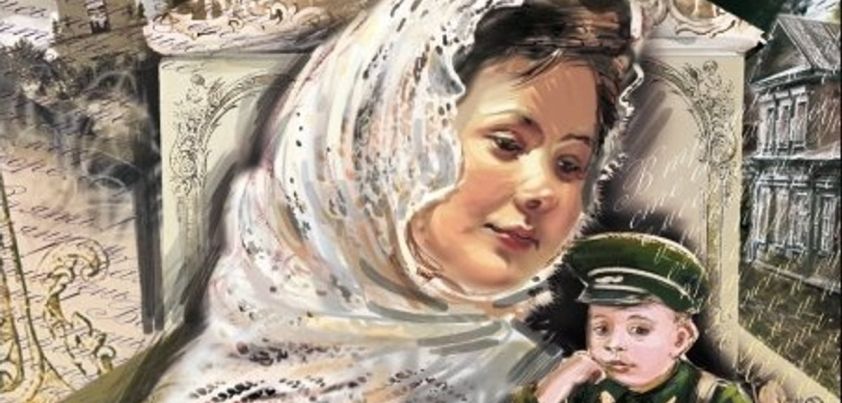 In psychological terms, Anton Chekhov’s ‘darling’ (Olga) suffers from Codependency Personality Disorder. More specifically, she is a vicarious codependent – someone who suspends their identity and gains fulfillment through the accomplishments of another. Olga’s ‘attachments’ in life include her father, a theatre manager, a timber merchant, a veterinary surgeon, and a young boy. Her relationship with the boy differs from the others. Being forced to assume a ‘motherly’ role rekindles Olga’s female identity. Sadly, motherhood and codependency don’t sit well together. In rediscovering her own identity, Olga begins to smother that of the boy. Themes: codependency, subservience, death, abandonment, identity, motherhood. More…