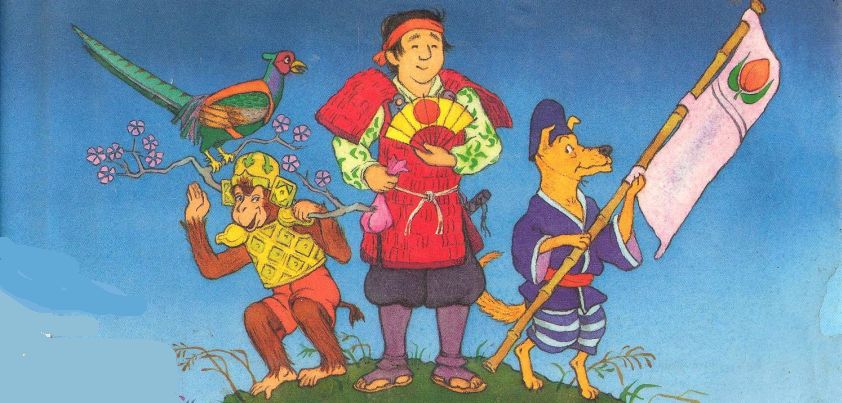
 In this famous Japanese folktale, a childless couple’s prayers are answered when a giant peach splits open to reveal a baby boy. The boy grows up to be the strongest and wisest lad in the land and, at fifteen, decides to give his poor parents an easier life by traveling to an island off the Northeast coast of Japan, destroying a band of cannibalistic demons that are terrorizing the land, and bringing back their treasure. Along the way he gathers troupe of anthropomorphic animal friends who, in predictable folktale form, help him easily win the day. More…
The Necessary Grace to Fall
 In this story by Gina Ochsner, an investigative assistant in the claims department of a life insurance company finds himself bored by both the routine of the job and his marriage. He compensates by taking a morbid interest in the unusual causes of death he encounters, and becomes obsessed with learning more about a woman from his childhood neighborhood who jumped/fell from a bridge. While sitting on a ledge of the same bridge trying to imagine her motivation and feelings, he has an epiphany that may change his life. Themes include alienation, guilt, death, suicide, obsession, redemption, hope. More…
The Star
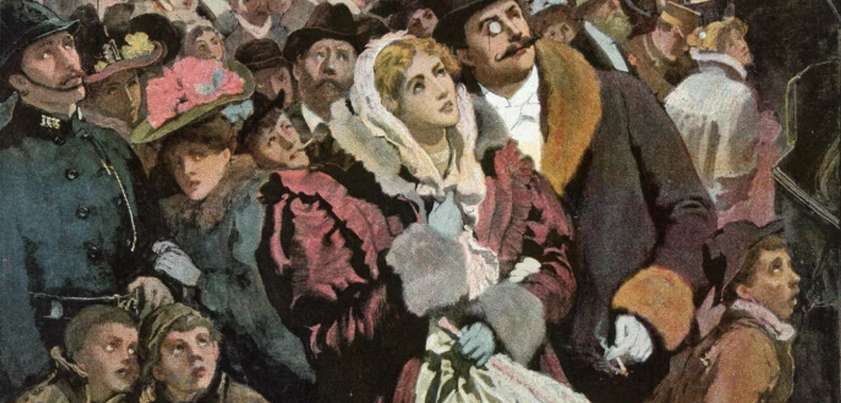 This apocalyptic story from H. G. Wells describes a near miss of Earth by a huge planetary fragment from outside the solar system. A somewhat disheartening theme is how insignificant the human race and its achievements are in the grand scheme of the universe. Part of the story’s appeal lies in questioning whether people would respond in a similar way if the same thing were to happen today. At first, people view the new “star” with excitement and anticipation. When a master mathematician makes dire predictions, many flee their cities in panic. But surprisingly, most do nothing until too late. More…
The Feather Pillow
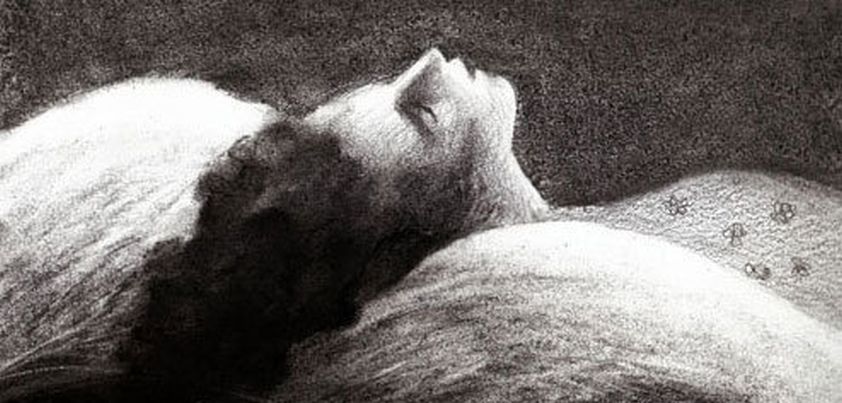 In this story by Horacio Quiroga a healthy young woman slowly wastes away and dies over the three months following her wedding. Her husband’s impassive manner, coupled with spending her days alone in his cavernous, unwelcoming house, destroy her childhood fancies of married life. Her fate is sealed when she decides to cast a veil over her former dreams and live like a sleeping beauty in the hostile house. Later, we learn that it is not their house that is hostile, but her feather pillow. Themes include innocence, love and marriage, isolation and loneliness, disillusionment, depression and death. More…
Carmilla
 This 1872 novella by Sheridan Le Fanu was ground-breaking in several ways. It is not only one of the first examples of vampire fiction (pre-dating Bran Stoker’s Dracula by 25 years), but also the first to infer a lesbian element to vampiric attraction. This vampire seems to have a taste for blue blood. Peasant victims die quickly, but two young aristocratic women enjoy her seductive company longer. Could Carmilla have something else in mind for these two, such as spending eternity together? Themes: patriarchy, social class, female sexuality, life and death, the supernatural. More…