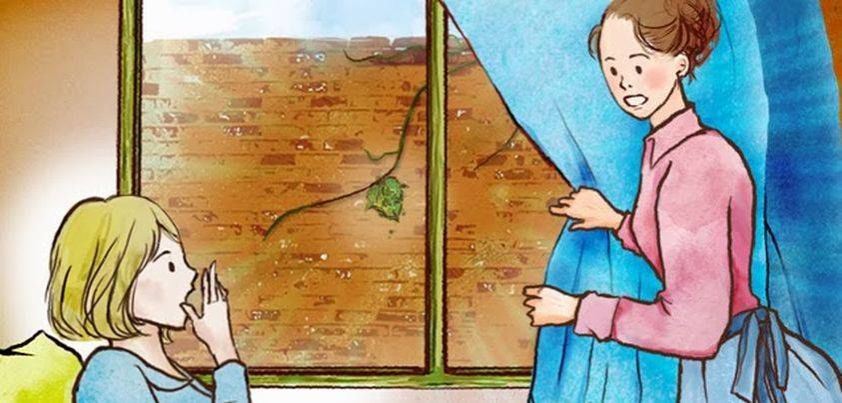
 This story by O. Henry is one that most who read it never forget. Two young women trying to make a living as artists share an apartment in New York City. One of them becomes very sick, and believes that she will die when the last leaf falls from an ivy plant on the wall opposite her window. An unlikely figure (an old, alcoholic, failed artist who rarely has a nice word for anyone) helps to save her. However, his act of kindness comes at a very high cost. Themes include friendship, defeatism vs. hope, compassion, sacrifice, art. More…
Waters of Gold
 This Chinese folktale retold by Laurence Yep is in two parts. First, readers encounter the kind-hearted Auntie Lily who has spent so much of her money helping others that she now lives in poverty. Her fortunes change for the better when she helps a filthy, foul-smelling beggar who everyone else ignores. Later, her greedy neighbour experiences a different result when, hoping for a similar reward, she helps the same man. The two parts show different sides of the “be kind to others” moral: kindness for kindness’s sake brings its own rewards; kindness in expectation of reward usually leads to disappointment. More…
This Way for the Gas, Ladies and Gentlemen
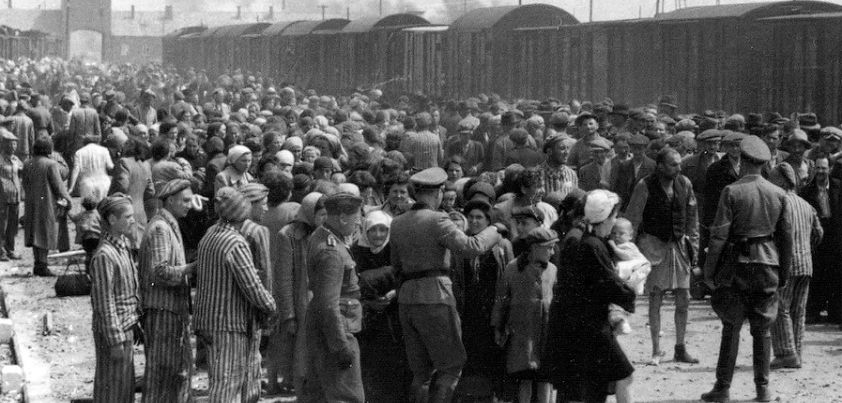 This almost clinical account of Tadeusz Borowski’s holocaust experiences explores an often overlooked aspect of the so-called “final solution”: how general prisoners forced to assist in sending the condemned to gas chambers became so desensitized to the brutality that many actively participated in it. Because of their access to discarded food and clothing, these men formed the “elite” among the prisoner hierarchy. In camp, their insensitivity to suffering prevailed and many looked down on and showed little compassion for the plight of “less fortunate” fellow inmates. Themes: man’s inhumanity to man, death and suffering, the survival instinct, detachment, guilt, rationalization. More…
Life in the Iron-Mills
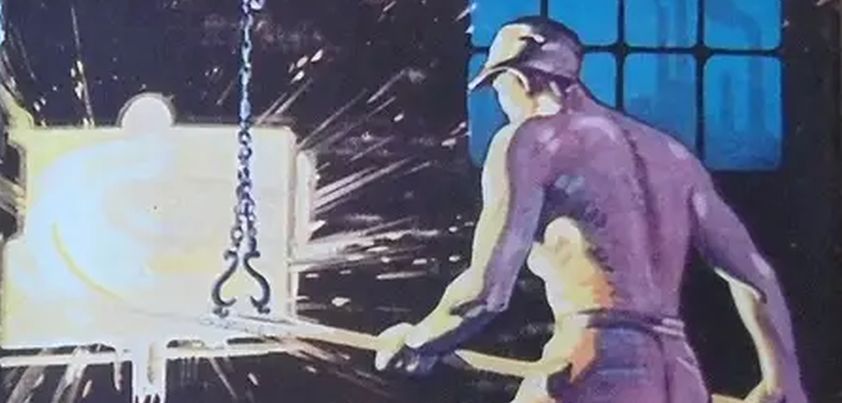 Set in the 1830s, this story by Rebecca Harding Davis highlights the desperate plight of mill and factory workers during the early stages of the industrial revolution. A young furnace attendant, ostracised by other iron-mill workers because of his mild manner and artistic leaning, lives in squalid conditions with his father and a mildly disfigured female cousin. The cousin, whose love for the man is not reciprocated, destroys both of their lives by stealing money to try to help him. Themes include social inequality, exploitation, poverty, artistry, lack of opportunity, unrequited love, crime and punishment, despair, redemption. More…
The Man with the Rose
 In this story by Manuel Rojas, an evangelical priest is predictably dismissive when a man says he has “black magical” powers. The man begs to be put to the test, claiming that, if locked in a room for an hour, he can retrieve any distant object the priest nominates. The priest’s orderly view of the universe is shattered; not only when the man hands him a unique rose he requested from a Santiago convent, but also by what he saw when he unlocked the door and crept into the room twenty-five minutes early. Themes include religion, disbelief, disillusionment, the supernatural. More…